
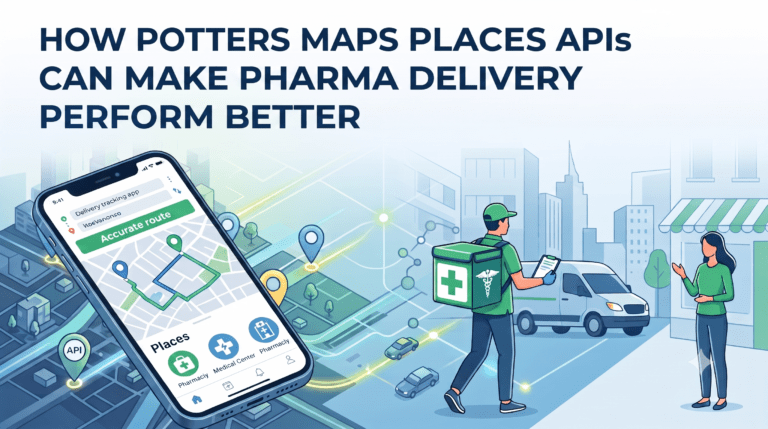
Online pharmacy and pharmaceutical delivery has grown from a convenience feature into a core part of modern healthcare access. Chronic disease patients now depend on scheduled home delivery of their maintenance medications. Elderly customers, immunocompromised individuals, and those in rural or remote locations rely on pharma apps to bridge distances that would otherwise stand between them and their prescriptions. According to industry analysis from Statista, the online pharmacy segment continues to grow at strong double-digit rates in many major markets, with a growing share of prescription volume now flowing through digital channels. This growth carries real responsibility. A late pizza is an inconvenience. A late prescription can be a medical event.
The apps that succeed in this category, and that earn the trust of patients, caregivers, and healthcare providers, are the ones that treat every layer of the delivery experience with the seriousness it deserves. Underneath every one of those layers sits a location intelligence infrastructure that determines whether the right medicine reaches the right person at the right time and place. This article looks at how a well-designed Places API layer transforms pharma delivery outcomes, and how the Potters Maps Places APIs are built to support exactly this category of high-stakes application.
Pharma delivery is not general e-commerce with pharmaceutical products bolted on. It carries distinctive operational characteristics that make the standard last-mile playbook insufficient on its own. Many medicines are time-sensitive, either because the patient needs them urgently or because they are cold-chain products whose efficacy degrades outside a narrow temperature window. Many patients receiving deliveries are elderly, mobility-limited, or immunocompromised, meaning that a failed delivery is not just a scheduling problem but a potential health risk. Regulatory frameworks in most markets impose additional verification requirements, from signature capture to age verification for controlled substances. And customer addresses skew towards demographic groups where address complexity, apartment identifiers, and building-level nuances matter more than average.
Each of these factors places a heavier burden on the location data layer than a comparable consumer delivery would. Precision, freshness, and consistency are not marginal advantages. They are foundational requirements.
For a typical online purchase, an address error results in a delivery attempt to the wrong door and a rescheduled second attempt. For a pharma delivery, an address error can mean a patient missing a dose, an insulin shipment sitting in the wrong lobby, or a controlled substance ending up in unauthorised hands. The stakes at intake are therefore materially higher than in general commerce, which makes the investment in address quality a health and safety consideration rather than an operational nicety.
The Potters Maps Autocomplete API addresses this at the point of order placement. As the patient or caregiver types their delivery address, the API surfaces real, validated candidates from the underlying places database, ensuring the address committed to the order is one that exists and can be reached. For addresses arriving through partner integrations, physician prescription systems, or bulk migrations from legacy platforms, the Potters Maps Address Validation API performs the same validation retrospectively, parsing each entry into structured components, verifying it against authoritative reference data, and standardising the format. In a category where a single wrongly delivered package can constitute a regulatory incident, this upstream cleanup dramatically reduces both operational cost and clinical risk.
Once an address is validated, the pharma delivery platform needs to convert it into a coordinate the routing engine can use. The precision of that coordinate directly affects how quickly, and how reliably, the delivery reaches the patient. For maintenance medication scheduled to arrive on a regular cadence, minor coordinate drift may only cost time. For urgent deliveries, such as post-hospital-discharge medication, chemotherapy support drugs, or refills a patient is running out of, that drift can translate into meaningful delays with clinical consequences.
The Potters Maps Forward Geocoding API returns coordinates that correspond to actual delivery entrances rather than approximated street centroids or block midpoints. In a residential complex where the pharmacy delivery entrance is behind the main building, or in a hospital campus with a dedicated pharmacy dispatch dock separate from the visitor entrance, this precision is what makes the difference between a delivery that arrives quickly and one that stalls while the rider circles the property looking for the right point. Enriched with attributes drawn from the underlying Potters Maps places database, each coordinate also carries context about the type of building, allowing dispatchers to apply appropriate service durations and access instructions to each stop.
Pharma delivery apps do not just deliver to patients. They also connect patients to the network of pharmacies, hospitals, and clinics that fulfill or dispense their orders. When a patient uploads a prescription, the app often needs to identify participating pharmacies within a reasonable radius, sometimes filtered by attributes such as 24-hour operation, stocking of specific drug categories, or affiliation with a specific insurance network. When a patient is being discharged from a hospital with a prescription that needs immediate fulfillment, the app needs to identify pharmacies close to the hospital that can turn the order around quickly.
The Potters Maps Search API, backed by a places database of over 70 million points of interest across multiple countries and territories, supports this kind of proximity and attribute-based query. Applications can query for pharmacies, hospitals, clinics, or diagnostic centres within a specified area, filter the results by relevant categories, and present them to the patient in a way that helps them make an informed choice. Because the underlying database is continuously refreshed, closures, relocations, and new openings propagate into the search results within short cycles rather than as annual updates.
Patients waiting for medication want the same delivery visibility they expect from any other online order, if not more. Anxiety around a delayed insulin shipment or a chemotherapy support drug is qualitatively different from anxiety around a delayed pair of shoes. The live tracking layer of a pharma delivery app is therefore both an operational tool for dispatchers and a therapeutic feature for patients, whose peace of mind is part of what the service is delivering.
The Potters Maps Reverse Geocoding API supports this by converting the continuous stream of GPS pings from each rider’s device into readable address updates. Instead of seeing a raw coordinate, the patient sees a meaningful location description such as the rider being two streets away, approaching their neighbourhood, or arriving at the building. Dispatchers see the same underlying data in a form that lets them intervene when a delay begins to develop rather than after the patient has already called to ask what happened. For elderly patients or caregivers coordinating between the patient, the delivery rider, and a physician, these clear, human-readable location updates significantly reduce the cognitive load of the delivery experience.
Pharma delivery routinely goes to demographics for whom the last few metres of the delivery present a disproportionate challenge. Elderly patients living in complex apartment buildings, caregivers coordinating for someone else in a gated community, or patients in independent living facilities with multiple wings all benefit enormously when the delivery rider arrives at the exactly correct location without having to walk the building or call the customer for directions. Every extra minute a rider spends searching is a minute during which cold-chain medicines are outside their intended temperature window and a mobility-limited patient is waiting.
The Potters Maps Location Image API closes this gap by providing imagery associated with specific delivery points, giving the rider a visual reference for the destination before they leave the vehicle. Instead of scanning a row of similar buildings, the rider compares the on-screen image with what is in front of them and identifies the right point in seconds. The Potters Maps POI Extraction API, which uses OCR and language models to extract structured information from images, supports the ongoing freshness of this visual layer by analysing storefront and building images captured in the field to detect changes in signage, entrances, or accessibility features. Combined with the Naksha data collection app, which allows field teams to capture new images and submit them for processing, this creates a continuously refreshed visual layer that keeps pace with the reality on the ground.
Pharma delivery increasingly extends beyond the home into last-mile logistics for hospitals, clinics, and outpatient facilities themselves. Bulk medication deliveries to hospital pharmacies, urgent transfers of speciality drugs between facilities, and scheduled restocking of clinic supplies all depend on accurate, current records of the healthcare facilities themselves.
The Potters Maps places database is continuously refreshed through AI-enhanced data processing, partner-sourced map data, and direct field collection through the Naksha data collection app, ensuring that healthcare facility records reflect current operational status rather than a frozen snapshot. New clinics opening, existing hospitals expanding into new wings, and speciality centres relocating all filter into the database within short refresh cycles. For pharma logistics operations planning routes and network coverage across a market, this freshness is what turns the location layer from a static reference into an operational asset that keeps up with the healthcare landscape.
Each of these capabilities improves pharma delivery outcomes on its own. Their combined effect is far greater than the sum of the parts. A pharma delivery app that validates every address at intake, geocodes to the actual patient entrance, tracks live with reverse-geocoded updates, supports riders with visual context at the destination, and searches a continuously refreshed database of pharmacies and healthcare facilities is fundamentally a different operation from one that improvises each of those steps from incomplete data.
The Potters Maps Places API and Custom API suite, combining Forward Geocoding, Reverse Geocoding, Autocomplete, Search, and Address Validation with the Location Image and POI Extraction APIs, provides this integrated foundation. Because every layer draws from the same continuously refreshed places dataset, every part of the operation operates on a consistent view of the world.
Pharma delivery is one of the most consequential categories of last-mile logistics because the stakes at every failure point are health stakes rather than just customer satisfaction stakes. A patient who does not receive their medication on time may miss a dose that matters clinically. A cold-chain drug that spends too long in transit may lose efficacy before it ever reaches the person who needs it. A prescription delivered to the wrong address may become a regulatory event. Underneath every one of these failure modes sits the quality of the location data feeding the delivery operation. Investing in a unified location intelligence layer such as the Potters Maps Places APIs and Custom APIs is therefore not just a technology decision for pharma delivery operators. It is a patient safety and clinical outcomes decision, and one of the highest-leverage investments available for building a pharma delivery platform that earns and keeps the trust of patients, caregivers, and healthcare providers.
Newsletter signup. Travel with confidence accurate road and traffic information.
© 2026 Potters Maps. All Rights Reserved.