
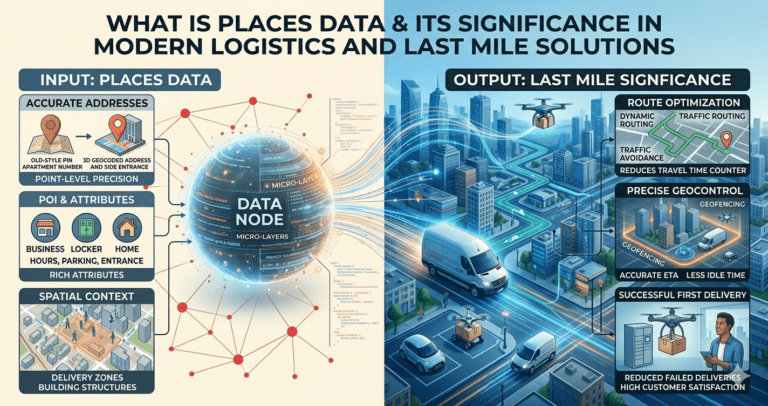
The movement of goods from a warehouse shelf to a customer’s doorstep is no longer a simple journey. It involves a web of decisions, each dependent on accurate, real-time knowledge of the physical world. At the center of this intelligence layer sits a category of information that the logistics industry has come to rely on heavily: places data. Understanding what places data is, how it is collected, and why it matters can help explain the transformation happening across supply chains, delivery networks, and urban mobility systems worldwide.
Places data refers to structured, machine-readable information about physical locations in the real world. This goes far beyond a simple address. A rich places data record might include a location’s geographic coordinates, its official and colloquial name, the category of business or point of interest it represents, its operating hours, access points, floor count, parking availability, pedestrian entry points, and even historical footfall patterns.
According to Precisely, location data encompasses any information that can be tied to a real-world place, and when enriched with attributes like business type, accessibility, or surrounding infrastructure, it becomes a powerful input for operational decision-making. The distinction between a bare coordinate and a fully attributed place record is the difference between knowing a dot exists on a map and understanding everything that makes that dot meaningful for a delivery driver, a route planner, or a supply chain analyst.
Places data is typically aggregated from multiple sources. These include government records and postal databases, satellite and aerial imagery, user-generated content from mapping platforms, mobile device signals, point-of-sale systems, and direct field surveys. The combination of these inputs creates a layered dataset that describes not just where something is, but what it is, who goes there, when it is active, and how it can be reached.
Modern logistics operates at a scale and speed that would have been unimaginable two decades ago. The rise of e-commerce, same-day delivery expectations, and complex multi-modal freight networks has placed enormous pressure on operators to make smarter routing, warehousing, and staffing decisions. Places data underpins many of these decisions.
When a logistics company is deciding where to open a new fulfillment center, for instance, it needs more than a cheap plot of land. It needs to understand proximity to population clusters, road network quality, zoning regulations, competing facilities, and the density of delivery addresses in surrounding zones. McKinsey and Company has noted that data-driven site selection in logistics can reduce operational costs significantly by aligning facility placement with actual demand geography.
At the route optimization level, places data informs decisions such as whether a building has a loading dock, what time a commercial receiver typically closes, which entrance is accessible by a large vehicle, and whether a residential address is in a gated community. These seemingly small attributes have outsized consequences for delivery efficiency. A driver who arrives at the wrong entrance or at a closed facility loses time that cascades into delays across an entire route.
The last mile is widely recognized as the most costly and operationally complex segment of the supply chain. According to research cited by Business Insider Intelligence, last mile delivery accounts for more than 53 percent of total shipping costs. This disproportionate cost stems from the fragmented, unpredictable nature of delivering to individual endpoints, whether residential addresses, apartment buildings, small businesses, or remote rural locations.
Places data is central to solving the last mile challenge because it provides the granularity that general mapping tools cannot. Consider the difference between navigating to a street address and navigating to the correct entrance of a 40-story residential tower with six separate lobbies, package rooms on floors 2 and 15, and a freight elevator that requires booking in advance. None of that information lives in a standard postal record. It requires enriched places data, often gathered through a combination of building-level surveys, tenant management systems, and crowdsourced driver feedback.
Companies like what3words have taken a different approach, dividing the entire surface of the earth into 3-meter squares and assigning each a unique three-word address. This system has found particular traction in regions with informal or inconsistent postal addressing, allowing deliveries to reach rural farms, festival sites, and informal settlements that a conventional address system would fail to locate at all.
A fundamental application of places data in logistics is geocoding: the process of converting a written address into geographic coordinates that can be used by navigation and routing software. Bad address data is one of the most persistent and costly problems in the industry. Failed deliveries, returned packages, and customer service overhead all trace back, in significant measure, to addresses that are incomplete, ambiguous, or simply wrong.
SmartyStreets, a provider of address verification tools, estimates that up to 20 percent of addresses entered during online checkout contain some form of error. Address standardization and validation tools, powered by comprehensive places datasets, correct these errors before a package ever enters the fulfillment workflow, preventing the cascade of costs that follows a misrouted shipment.
Geocoding quality varies significantly by geography. In dense urban centers with well-maintained postal systems, geocoding accuracy is generally high. But in peri-urban areas, fast-growing cities in emerging markets, or regions where informal development has outpaced official record-keeping, geocoding can be deeply unreliable. Logistics operators in these environments depend on alternative places data sources, including mobile network-derived location signals, community-mapped datasets from platforms like OpenStreetMap, and proprietary field surveys.
Modern route optimization is a computational problem of enormous complexity. A delivery vehicle serving 80 stops in a day faces a combinatorial challenge that brute-force calculation cannot efficiently solve. Algorithms built on top of places data use attributes like stop density, traffic patterns, road restrictions, time windows, and address accessibility to generate routes that minimize time, fuel consumption, and failed delivery attempts.
Potters Maps Places API and similar services expose places data through APIs that logistics software providers use to enrich their own routing engines and route optimization APIs. These integrations allow a delivery management system to know, for example, that a particular retail client has a receiving dock that opens at 7am and closes by noon, or that a hospital campus routes freight deliveries through a separate entrance on the east side of the building.
Real-time places data is equally important. Traffic incidents, road closures, construction zones, and temporary restrictions can invalidate a pre-planned route within minutes of a driver departing. Dynamic routing systems that ingest live traffic feeds alongside a rich layer of static places attributes can recalculate optimal paths on the fly, preserving delivery windows even when conditions change rapidly.
As cities grow denser and municipal authorities impose stricter regulations on commercial vehicle movements, places data has taken on new relevance for compliance and urban access management. Low-emission zones, time-restricted delivery windows, weight limits on certain roads, and pedestrianized areas all require logistics operators to have precise, up-to-date knowledge of the regulatory geography they are operating within.
Geofencing technology, which uses places data to define virtual boundaries around physical areas, enables automated alerts and route adjustments when a vehicle approaches a restricted zone. Samsara, a fleet management technology provider, describes geofencing as a core tool for ensuring regulatory compliance, automating arrival and departure logging, and triggering customer notifications based on proximity to a delivery location.
Urban consolidation centers and micro-fulfillment hubs, which are increasingly being deployed in city centers to shorten delivery distances and reduce the number of vehicle trips, depend on precise places data to operate efficiently. Knowing the catchment area of each hub, the walking and cycling accessibility of surrounding blocks, and the cargo bike routes available within the zone allows operators to design last mile networks that work within the constraints of dense urban environments.
Several technology trends are dramatically expanding both the richness of places data and the sophistication of its applications in logistics.
Lidar scanning and photogrammetry, technologies originally developed for autonomous vehicle development, are now being used to create millimeter-accurate 3D models of urban environments. These models capture building geometry, entrance configurations, loading area dimensions, and surrounding infrastructure in a level of detail that supports entirely new categories of logistics planning. HERE Technologies, a mapping platform specializing in automotive and logistics applications, uses HD mapping techniques to create environments in which autonomous vehicles and advanced driver assistance systems can navigate with precision.
Artificial intelligence and machine learning are being applied to places data to derive new attributes that were previously invisible. By analyzing patterns in delivery attempt data, companies can predict which addresses are likely to require a second attempt, which buildings have unpredictable access conditions, and which time windows are most likely to result in a successful handoff. This transforms places data from a static geographic record into a living, predictive asset.
Drone and autonomous ground vehicle delivery, while still in relatively early commercial deployment, places extreme demands on places data quality. An autonomous system navigating to a residential address without a human driver’s ability to improvise needs to know not just where the address is but exactly where the safe landing or drop-off zone is, what obstacles exist along the approach path, and what local regulations govern the delivery method. Companies like Zipline and Starship Technologies are building proprietary places data layers to support their autonomous delivery networks.
The value of places data is entirely contingent on its accuracy, completeness, and freshness. A dataset that was accurate two years ago may already be substantially degraded as businesses open and close, roads are modified, buildings are renovated, and postal systems are updated. This decay problem is one of the central challenges in places data management.
Foursquare, a company that has built one of the most comprehensive commercial places databases in existence, estimates that a significant proportion of business listing attributes change within any given year. Maintaining data quality at scale requires continuous ingestion of new signals, automated change detection, and human review workflows to resolve conflicting information.
For logistics operators, the consequences of stale places data are direct and measurable: failed deliveries, customer complaints, penalty charges from commercial receivers, and driver inefficiency. The investment in high-quality, continuously refreshed places data is not a discretionary technology expense. It is a core operational requirement.
The logistics companies that are outperforming their peers on last mile efficiency are, in many cases, those that have invested most heavily in location intelligence capabilities. This includes not just purchasing high-quality commercial places data, but building proprietary enrichment layers from their own operational data: driver feedback, delivery attempt outcomes, customer preferences, and building access instructions gathered over thousands of stops.
UPS, through its ORION route optimization system, has demonstrated how deeply integrated location intelligence can transform operational economics at scale. The system ingests a rich layer of places attributes alongside real-time conditions to continuously refine delivery routes, and the company has credited it with saving hundreds of millions of miles driven annually.
Amazon’s delivery infrastructure, detailed in various supply chain analyses, is similarly built on an extraordinary accumulation of places intelligence, including proprietary data on building access, parking availability, safe drop-off locations, and customer delivery preferences at the individual address level. This information, gathered from millions of daily deliveries, creates a location intelligence moat that is extremely difficult for competitors to replicate.
Places data has moved from a supporting layer of maps and directories to a foundational input for modern logistics operations. It shapes where warehouses are built, how routes are planned, whether deliveries succeed on the first attempt, and how autonomous systems will eventually navigate the built environment without human oversight. As delivery volumes grow, customer expectations rise, and urban environments become more complex and regulated, the quality and depth of places data will increasingly determine which logistics operators thrive and which fall behind.
The organizations like Potters Maps are investing today in better geocoding, richer address validation, real-time place attribute maintenance, and AI-driven location intelligence are building capabilities that will compound in value over time. In an industry where margins are thin and the difference between a successful and a failed delivery can determine a customer relationship, places data is not just a technical asset. It is a strategic one.
Newsletter signup. Travel with confidence accurate road and traffic information.
© 2026 Potters Maps. All Rights Reserved.