
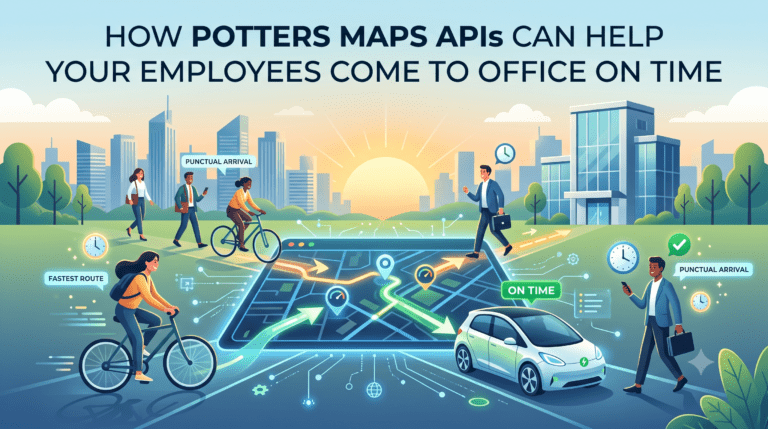
The five-day office week is back for many organisations, and with it a familiar set of headaches unpredictable traffic, missed shuttles, employees stuck at unmarked pickup points, and a growing list of Monday-morning apologies landing in HR inboxes. Industry surveys suggest that a meaningful share of workplace lateness has nothing to do with employee intent and everything to do with the infrastructure that surrounds the commute.
For CHROs, admin heads, and workplace operations leaders, this is more than an inconvenience. Late arrivals ripple into missed stand-ups, delayed client calls, poor utilisation of expensive real estate, and an erosion of the “we show up together” culture that in-person work is supposed to deliver.
The good news is that most of these frictions are solvable and increasingly, they are solvable through location intelligence. This is where Potters Maps, an AI-enhanced mapping company that provides mapping and location APIs to enterprises worldwide, has been quietly changing how corporate transportation, employee shuttles, and commute planning tools operate.
Let’s look at how our suite of APIs and location products can be used to build a system where employees consistently arrive on time and actually enjoy the ride in.
The single biggest reason employees miss their morning shuttle is not laziness it is ambiguity. “Sector 21 Main Gate” means one thing to the driver, another thing to the new joiner, and something else entirely to the map app they are all using. Compound this across hundreds of pickup points in a metro city, and you have a scheduling nightmare.
The Places API from Potters Maps solves this at the data layer. Instead of relying on generic geocoding that often points to the wrong side of a divided highway, the Places API resolves an address or landmark into a precise, enriched Point of Interest with attributes such as entry gates, nearby transit stops, standard drop-off zones, and category metadata. When integrated into an employee transport application, this means every pickup point is standardised, verified, and unambiguous.
For workplace teams, the impact is immediate. New joiners can self-onboard onto shuttle routes without escalations. Drivers see the same coordinates the employee sees. Reallocations happen in seconds instead of hours.
Every enterprise commute program eventually runs into the same question where do our people actually live, and what is around them?
Potters Maps maintains a Places Database of over 70 million Points of Interest globally, each enriched with detailed attributes such as name, address, category, and operational information. For an employee transport team, this database is the raw material that makes intelligent routing possible.
Some real-world applications include:
Instead of guessing, HR and admin teams can plan routes on top of a verified geographical reality which directly reduces commute time and improves punctuality.
A quiet productivity killer in corporate commutes is the “which building is it?” moment a driver arriving at a lane with three identical towers and no signage, or an employee waiting outside the wrong gate. Traditional maps do not solve this, because they only show a dot on a road.
The Imagery Platform enriches maps with ground-truth street-level imagery, meaning both the driver and the employee can see exactly what the pickup point looks like the colour of the building, the shop next door, the direction the gate faces. Corporate mobility apps that embed this kind of visual context see dramatically fewer “I can’t find you” calls in the critical 7 to 10 AM window.
Coupled with this, the Location Image API inside Potters Maps’ Custom APIs suite lets applications programmatically pull visual snapshots of pickup coordinates. For a shuttle app used by field workers or drivers who may not read the local language, this is transformative the visual itself becomes the address.
Cities change. New flyovers open, gates get shifted, one-way rules flip overnight, and construction closes a familiar road for six months. Any commute system built on static maps will slowly degrade.
Potters Maps addresses this with the Naksha Data Collection App, a crowdsourced tool that allows contributors to update ground-truth information about places and roads while earning rewards. For enterprises, this means the map data powering employee shuttles stays fresh new corporate parks, revised entry gates, and updated traffic diversions are captured close to real time rather than months later.
Some progressive employers have even piloted internal versions of this workflow, allowing employees themselves to flag pickup-point issues from within their shuttle app. The result is a system that gets more accurate every week instead of decaying month over month.
Punctuality is not just about knowing where to go it is about knowing when to leave. This is where predictive location intelligence becomes powerful.
Potters Maps’ AI/ML Models can be leveraged to build commute-time predictors that account for traffic patterns, weather, and localised congestion signals. Applied to an employee shuttle system, these models can dynamically adjust pickup times, warn employees about likely delays before they leave home, and reroute drivers around bottlenecks in real time.
For a workforce trying to hit a 9:30 AM stand-up, receiving a “leave five minutes earlier today” nudge at 7:45 AM is far more valuable than an apology at 9:45 AM.
Every enterprise commute program has its own quirks biometric gate integrations, campus shuttles, executive car services, women-safety protocols after dark, or peer-to-peer carpool matching between colleagues. Off-the-shelf mapping products rarely accommodate all of these.
The Custom APIs offering from Potters Maps allows workplace tech teams to build tailored location services on top of a robust map stack. Whether it is a POI Extraction API that reads storefront imagery to auto-populate new pickup landmarks, or a bespoke routing service that respects campus one-way rules, the platform is designed to be composable.
This matters because employee transportation is not one problem but a hundred small ones. Solving them requires a partner that can be shaped to fit the organisation, rather than forcing the organisation to fit the platform.
When location intelligence is layered into an employee transportation program, the returns show up across the P&L:
The return-to-office debate is often framed as a question of policy how many days, which days, and how strictly enforced. But policy alone cannot fix a broken commute, and no attendance mandate has ever made traffic disappear. The organisations that will win the RTO transition are the ones that treat the journey to work as a design problem, not a discipline problem.
That reframing changes everything. Instead of asking, “How do we get employees to show up on time?” workplace and HR leaders can start asking, “How do we build a commute that arrives on time by default?” The answer, increasingly, sits at the intersection of accurate location data, real-time intelligence, and thoughtfully engineered APIs.
Potters Maps offers a purpose-built stack for exactly this challenge. The Places API removes the ambiguity that plagues pickup points. The Places Database gives planners a verified view of where employees actually live and travel through. The Imagery Platform eliminates the “which building is it?” confusion that costs precious minutes every morning. The Naksha Data Collection App keeps that intelligence fresh as cities evolve. The AI/ML Models turn historical patterns into forward-looking guidance. And the Custom APIs let enterprises shape all of this to their unique operational reality.
Individually, each of these products solves a specific commute friction. Together, they form the connective tissue of a modern employee transportation program one where drivers know exactly where to be, employees know exactly when to leave, and admin teams stop spending their mornings firefighting.
On-time arrival is not a cultural virtue that needs to be preached. It is an outcome that can be engineered. With the right location intelligence in place, punctuality stops being the exception and becomes the quiet, reliable default and that, more than any policy memo, is what makes an office worth coming back to.
Newsletter signup. Travel with confidence accurate road and traffic information.
© 2026 Potters Maps. All Rights Reserved.