
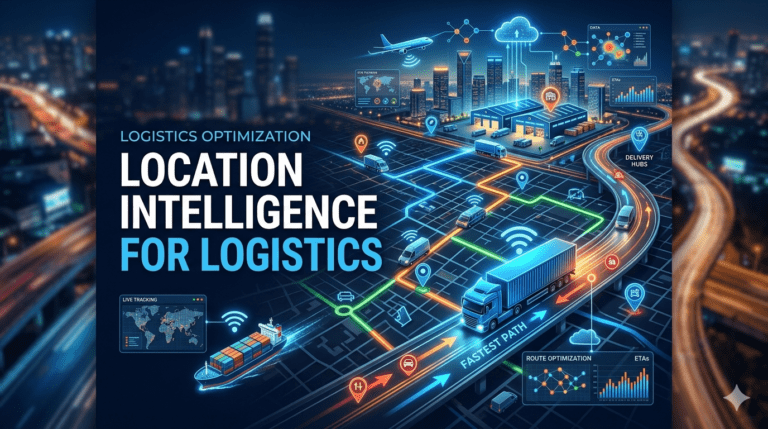
Every logistics decision is, at its core, a location decision. Where to build a warehouse. Which route a truck should take. Where a new retail store would capture the most foot traffic. Which supplier is geographically vulnerable to a specific climate risk. Whether a driver is heading toward the right delivery point or the wrong one. Strip away the financial models, the process frameworks, and the management jargon, and what remains is a simple question that recurs at every stage of the supply chain: where?
Location intelligence is the discipline of answering that question with data rather than intuition. It takes raw spatial information, coordinates, addresses, road networks, points of interest, satellite imagery, traffic patterns, and transforms it into actionable insight that drives better decisions. In logistics, where the margin between profit and loss often comes down to kilometres saved, minutes recovered, or deliveries completed on the first attempt, location intelligence has moved from a supporting technology to a foundational one.
The logistics industry entered 2026 under more pressure than at any point in its modern history. Operational costs are climbing. Labour shortages persist across every major market. Customer expectations for speed, accuracy, and transparency continue to tighten. Supply chain disruptions, once treated as exceptional events, have become a permanent feature of the operating environment. In this context, the companies gaining ground are not necessarily those with the largest fleets or the lowest costs. They are the ones with the best spatial awareness, the ones who can see their networks, their assets, their risks, and their opportunities through the lens of location.
Location intelligence is the process of deriving meaningful insight from geospatial data. It combines geographic information systems, mapping technology, spatial analytics, and increasingly, artificial intelligence and machine learning to help organisations understand the spatial relationships that affect their operations. In logistics, this translates into a set of capabilities that touch every link in the supply chain.
At the most basic level, location intelligence means knowing precisely where things are: vehicles, warehouses, customers, suppliers, competitors, and hazards. But the real value emerges when that positional awareness is combined with context. Knowing that a delivery vehicle is at a specific set of coordinates is useful. Knowing that it is twenty minutes behind schedule because of a traffic incident on a specific highway, that the next three stops on its route have narrow delivery windows, and that a reassignment of one stop to a nearby vehicle would recover the schedule, is transformative.
This contextual, layered understanding of geography is what separates location intelligence from simple GPS tracking. Tracking tells you where something is. Location intelligence tells you what that position means and what you should do about it.
The foundation of all location intelligence is data. Not just any data, but spatial data that is comprehensive, accurate, and current. A logistics operation cannot make good location-based decisions if its underlying geographic information is incomplete or outdated. This is why the quality of spatial data infrastructure, including the places databases, address repositories, imagery platforms, and detection models that underpin modern mapping, matters so profoundly.
Every location intelligence capability in logistics ultimately rests on the quality and breadth of the underlying spatial data. This data comes in several forms, each serving a different analytical purpose.
Points of Interest, or POI data, represents the commercial and civic infrastructure of a geography: every shop, restaurant, hospital, government building, warehouse, and service station mapped with its precise coordinates, name, category, operating hours, and other attributes. For logistics operators, POI data is essential for understanding the landscape in which deliveries occur.
Consider a food delivery platform expanding into a new city. Before it can plan delivery zones, estimate travel times, or forecast demand, it needs to know where the restaurants are, where the customers live, and what other commercial activity exists in the area. A comprehensive POI database that covers millions of real-world locations with detailed attributes provides this foundation. The difference between a database with 70 million enriched Points of Interest and a sparse, incomplete dataset is the difference between planning with confidence and planning with guesswork.
For market research and retail planning, POI data reveals competitive density, footfall potential, and whitespace opportunities. A logistics company evaluating where to place a new distribution hub can overlay POI data with demand data to identify the location that minimises average delivery distance to its customer base. A retailer deciding where to open a new store can analyse how many competing outlets already exist within a specific radius. These are spatial questions that can only be answered with comprehensive, accurate place data.
Maps and coordinates describe the world abstractly. Imagery shows it concretely. For logistics operations, the gap between what a map says and what a driver actually encounters at the delivery point can be the gap between a successful delivery and a failed one.
An address may resolve to the correct building, but the building may have multiple entrances, a gated courtyard, or a loading dock accessible only from a specific side street. A coordinate on a map cannot convey this. A photograph can. An imagery platform that integrates ground-truth visual information into the mapping layer gives planners and drivers the context they need to navigate complex delivery environments without wasted time or failed attempts.
The value of imagery extends beyond individual deliveries. At scale, street-level imagery becomes a dataset that can be analysed for infrastructure conditions, road quality, signage, accessibility, and urban change. Logistics planners evaluating a new service area can review imagery to assess road conditions before committing resources. Urban planners can track how commercial districts evolve over time. The visual layer turns the map from a schematic into a living representation of the physical world.
Raw imagery is useful, but processed imagery is powerful. Modern AI and machine learning models can automatically extract structured information from photographs, identifying objects, reading text, classifying scenes, and detecting changes that would take human analysts weeks to catalogue manually.
In logistics and transportation, this capability has immediate practical applications. A traffic signs and asset detection model that processes street-level imagery can automatically identify speed limits, weight restrictions, road closures, and infrastructure conditions across an entire road network. This data feeds directly into routing algorithms, ensuring that vehicles are not directed down roads that are restricted, under construction, or otherwise unsuitable.
Similarly, a POI extraction API that uses OCR and large language models to read storefront signage and extract business information from photographs can keep place databases current without requiring manual surveys. A new restaurant opens on a commercial street. Within days, the imagery platform captures it. The AI model reads the signage, categorises the business, and adds it to the database. The logistics platform that depends on that database now knows the restaurant exists and can route deliveries to it accurately.
For privacy-sensitive applications, particularly in regions governed by GDPR or equivalent regulations, a blurring API that automatically anonymises faces and licence plates in imagery ensures that data collection respects legal requirements without sacrificing the value of the visual data itself. This is not a peripheral concern. It is a compliance requirement that can determine whether a company is able to operate its imagery collection programme at all.
The applications of location intelligence in logistics are not theoretical. They address concrete, recurring operational problems that cost the industry billions of dollars annually.
Failed deliveries are one of the most expensive problems in last-mile logistics. Industry estimates suggest that between 5 and 10 percent of all delivery attempts fail on the first try, with each failure costing the operator between USD 12 and USD 20 in reattempt costs, customer service handling, and lost productivity. The most common cause is not that the driver was late or the customer was absent. It is that the address was wrong.
Customer-entered addresses are messy. They contain abbreviations, misspellings, missing postal codes, and ambiguous formatting. In many emerging markets, formal addressing systems are inconsistent or non-existent, and customers describe their locations using landmarks rather than structured addresses. Without a robust spatial data layer that can resolve these imprecise inputs into accurate coordinates, the driver is guessing, and guessing is expensive.
A comprehensive places database and location API integrated at the point of order entry can match partial or ambiguous addresses to verified locations, dramatically reducing the rate of misdeliveries. When the system can also return a location image showing the storefront or building at the delivery point, the driver has visual confirmation in addition to coordinates, eliminating the last layer of ambiguity.
Deciding where to position warehouses, distribution centres, and fulfilment hubs is among the most consequential decisions a logistics operator makes. A poorly located facility adds unnecessary kilometres to every route that originates from it, compounding costs over thousands of deliveries per day for years.
Location intelligence transforms network design from an exercise in managerial intuition into a data-driven optimisation problem. By overlaying demand data, customer density maps, competitor locations, road network connectivity, and real estate availability on a spatial analytics platform, planners can model the impact of different facility placements before committing capital. The same analysis can identify underserved areas where a new facility would capture disproportionate value, or overserved areas where consolidation would reduce costs without degrading service levels.
The richness of the underlying data determines the quality of these analyses. A POI database with detailed attributes, including business categories, operating hours, and precise coordinates, provides the demand-side intelligence that makes network models accurate. Imagery data provides the supply-side context, revealing road conditions, physical constraints, and the practical realities of operating in a specific location.
Once vehicles leave the depot, maintaining visibility and control over fleet operations depends on a continuous stream of location data. Real-time tracking answers the immediate question of where each vehicle is. Location intelligence answers the deeper questions of whether it is on schedule, whether its current position is consistent with its planned route, and whether any intervention is needed.
Driver navigation is the point where location intelligence meets execution. A navigation system that guides a driver to the correct entrance of a commercial complex, accounts for vehicle-specific restrictions like height or weight limits, and dynamically adjusts the route based on current traffic conditions reduces dwell time, improves on-time performance, and prevents the kind of wasted kilometres that accumulate invisibly across a large fleet.
The accuracy of navigation depends directly on the accuracy of the underlying map data. Roads change. New construction reroutes traffic. Temporary restrictions close lanes or bridges. A spatial data infrastructure that continuously collects and processes ground-truth information keeps the map current, and a current map keeps the driver on the right path.
The logistics operators who have invested most heavily in location intelligence share a common characteristic: they treat spatial data as a strategic asset rather than a commodity input. They maintain their own spatial data pipelines or partner with providers who can guarantee freshness, accuracy, and breadth. They integrate location intelligence into every stage of their planning and execution workflow, from network design and demand forecasting through to route planning, real-time tracking, and delivery verification. They use AI and machine learning not as experimental add-ons but as production systems that continuously extract value from spatial data at scale.
The competitive implications are straightforward. A logistics company with superior location intelligence delivers more accurately, plans more efficiently, navigates more precisely, and adapts more quickly than one relying on stale or incomplete geographic data. Over thousands of deliveries per day, these small advantages compound into measurable differences in cost per delivery, customer satisfaction, and operational resilience.
The organisations building this advantage are not necessarily the largest. They are the ones who understand that the quality of their spatial data layer determines the ceiling of their operational performance, and who invest accordingly. Whether that means building on a comprehensive POI database with tens of millions of verified locations, integrating custom location APIs that provide visual context and AI-powered data extraction, deploying imagery platforms that capture and process ground-truth data across their operating territories, or leveraging AI and ML models that automate everything from privacy compliance to infrastructure detection, the pattern is consistent. Better spatial data produces better logistics outcomes.
Location intelligence is not a feature to be added to a logistics operation. It is the lens through which every logistics decision should be made. The companies that see their world most clearly are the ones that move through it most efficiently. And in an industry where efficiency is survival, clarity is the ultimate competitive advantage.
Newsletter signup. Travel with confidence accurate road and traffic information.
© 2026 Potters Maps. All Rights Reserved.