
Every time you check the weather on your phone, book a ride on a ride-hailing app, pay for something online, or watch a video stream load instantly, you are witnessing the work of an API. You do not see it. You are not meant to. APIs operate quietly in the background, doing the unglamorous but essential work of moving data between systems that were never designed to talk to each other directly. Without them, the modern software experience would not exist. Apps would be islands. Websites would be static pages. The seamless, connected, on-demand world that defines digital life in 2026 runs on a foundation of APIs.
Yet for something so fundamental, the term remains poorly understood outside of software engineering circles. Business leaders hear about APIs constantly in vendor pitches and strategy meetings, but rarely get a clear explanation of what they actually are or why they matter. Marketing teams know that “API integration” is a feature their platforms should support, but cannot always articulate what that means for the customer experience. Even technical teams sometimes struggle to communicate the value of APIs to the colleagues who fund their work.
This guide explains what APIs are in plain language, how they work, why they have become the backbone of nearly every digital product, and how location-data APIs in particular are transforming the way businesses build mapping, logistics, and location-aware applications.
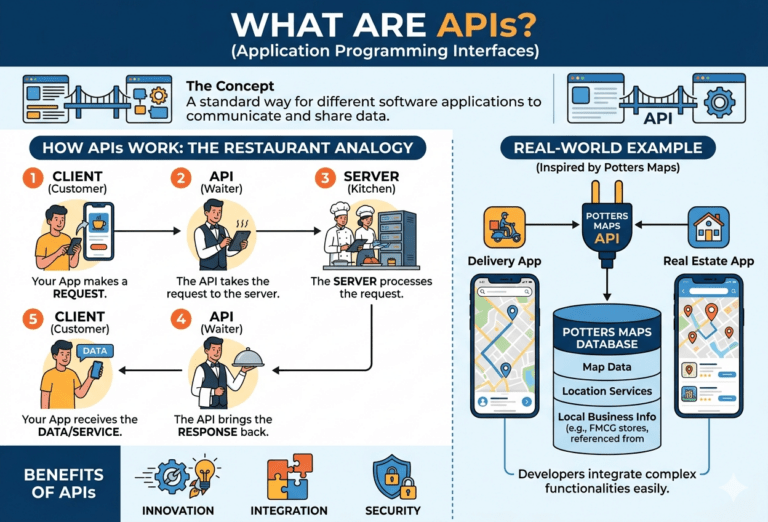
API stands for Application Programming Interface. The term sounds intimidating, but the concept is straightforward. An API is a set of rules that allows one software system to request information or services from another software system in a predictable, structured way.
The classic analogy is a restaurant. When you sit down at a table, you do not walk into the kitchen, find the chef, and explain how you would like your meal prepared. Instead, you read a menu, tell the waiter what you want, and the waiter takes your order to the kitchen. The kitchen prepares your dish according to its own internal processes, which you do not need to understand, and the waiter brings the finished meal back to your table. The waiter is the API. The menu is the API documentation. The kitchen is the underlying system that does the actual work.
In software terms, an API is the interface that lets one application ask another application for something specific, in a format both sides agree on, without either application needing to know how the other works internally. A weather app does not need to operate its own network of meteorological sensors. It calls a weather API, sends a request that says “give me the current conditions for this latitude and longitude,” and receives a structured response containing temperature, humidity, wind speed, and forecast data. The weather app then displays that data however it likes. The complexity of measuring, modelling, and forecasting weather is hidden behind a simple interface.
This separation of concerns is the entire point of APIs. They let software developers build powerful applications by combining capabilities from many different sources, without having to build every capability from scratch.
” Requests, Responses, and the Language of Software “
At a technical level, most modern APIs work over the same internet infrastructure that powers websites. When an application makes an API call, it sends an HTTP request to a specific web address, often called an endpoint. The request includes information about what the application wants: the type of data being requested, any parameters or filters, and authentication credentials that prove the application is allowed to access the service.
The server that hosts the API receives the request, processes it, fetches or computes the requested information, and sends back a response. The response is typically formatted in a structured data language, most commonly JSON (JavaScript Object Notation), which both humans and machines can read. The application then takes that structured data and uses it however it needs to: displaying it on a screen, storing it in a database, feeding it into another calculation, or passing it along to yet another system.
The exchange usually takes a fraction of a second. A modern smartphone app might make dozens of API calls in the few seconds between when you tap an icon and when the app finishes loading. Each call is independent. Each call is fast. And each call is made possible by the fact that the API publisher has documented exactly what requests they accept and what responses they return, so any developer can integrate the service into their own application.
Authentication is the security layer that ensures only authorised applications can use a given API. Most commercial APIs require an API key, a unique identifier issued to each developer or organisation that grants access. The key allows the API provider to track usage, enforce rate limits, bill customers based on consumption, and revoke access if the key is misused.
Not all APIs are alike. They serve different purposes and follow different design philosophies. Understanding the main categories helps clarify when and why each type is used.
Open APIs, sometimes called public APIs, are made available to any developer who wants to use them. The provider publishes the documentation, often offers a free tier to encourage adoption, and allows third parties to integrate the service into their own products. Most consumer-facing APIs from major technology companies fall into this category. Open APIs are how an entire ecosystem of weather apps, mapping tools, payment processors, and social media integrations exists.
Partner APIs are restricted to specific business partners. They are typically used when two companies need to share data or functionality but the integration is too sensitive or specialised to expose publicly. A logistics provider might offer a partner API to its largest enterprise customers, allowing them to query shipment status programmatically while preventing competitors from accessing the same data.
Internal APIs, also called private APIs, are used inside a single organisation to let different software systems communicate. A large retailer might have internal APIs that let its e-commerce platform talk to its inventory system, its payment processor, its fulfilment network, and its customer service tools. These APIs are not exposed to the public, but they are no less important. They are what allow large organisations to operate as integrated systems rather than collections of disconnected applications.
Composite APIs bundle multiple operations into a single call. Instead of forcing the client application to make several separate requests, a composite API performs the entire workflow on the server and returns a consolidated result. This is particularly useful in mobile applications where minimising the number of network round-trips improves performance and battery life.
For businesses, APIs are not just a technical detail. They are a strategic asset. The companies that have invested most heavily in APIs are also, not coincidentally, among the most successful technology businesses of the past two decades.
The reason is simple: APIs turn capabilities into building blocks. A company that exposes its core functionality through well-designed APIs can be integrated into a thousand different products built by other developers, multiplying its reach without multiplying its sales force. A company that consumes APIs from specialised providers can build sophisticated products in weeks rather than years, focusing its engineering resources on the unique value it brings rather than reinventing capabilities that already exist in mature form.
The economics are compelling. Building a global mapping platform from scratch would require billions of dollars and decades of effort. Building an application that uses a mapping API costs almost nothing in comparison. The same logic applies to payment processing, identity verification, cloud storage, machine learning, language translation, and countless other capabilities. APIs are the mechanism by which the work of specialists becomes available to generalists.
This is why “API-first” has become a guiding principle in modern software development. Rather than building an application and then adding APIs as an afterthought, API-first organisations design their APIs first and treat the user-facing application as just one consumer among many. This approach forces clean architecture, encourages reusability, and creates the optionality to build new products and partnerships on top of the same underlying capabilities.
Among all the categories of APIs available today, location and mapping APIs occupy a uniquely important position. The reason is that almost every modern application has some relationship to physical space. E-commerce platforms need to know where customers live to deliver products. Ride-hailing apps need to match riders with nearby drivers. Retail businesses need to understand the demographics around their stores. Logistics operators need to plan routes, track vehicles, and verify delivery locations. Insurance companies need to assess risk based on geography. Real estate platforms need to display properties on maps.
In every one of these cases, the application needs structured, accurate, current data about places, addresses, coordinates, road networks, and points of interest. Building this data infrastructure independently is impossible for almost any business. The cost of collecting, cleaning, validating, and continuously updating global location data runs into the hundreds of millions of dollars. The expertise required to maintain it is concentrated in a small number of specialised companies. The only practical way to access it is through APIs.
This is where providers like Potters Maps have built their value proposition. By aggregating data from reliable sources, enriching it with AI and machine learning models, and exposing it through clean, well-documented APIs, location data providers give application developers everything they need to build sophisticated, location-aware products without owning a single satellite, street imaging vehicle, or surveying team.
One of the most common requirements in any location-aware application is access to a comprehensive database of places. A delivery app needs to know what businesses exist at a given address. A travel planner needs to recommend restaurants, hotels, and attractions. A market research tool needs to count how many competing stores exist within a specific radius. All of these use cases depend on a Points of Interest (POI) database that is broad enough to cover the categories that matter and accurate enough to be trusted.
The Potters Maps Places Database addresses this need with a repository of over 70 million Points of Interest enriched with detailed attributes including names, addresses, categories, and opening hours. Through API access, developers can query this data programmatically, integrating rich place information into their own applications without having to build and maintain a POI database of their own. This is the API value proposition in its purest form: years of data collection and enrichment work, made available through a few lines of code.
Some applications need more than basic place data. Field workers, delivery drivers, and surveyors often need visual confirmation that they are at the correct location. A simple address and a coordinate are not always enough to identify a building in a dense urban environment or a complex commercial property. A photograph of the storefront, combined with the address, eliminates the ambiguity entirely.
The Custom APIs from Potters Maps include a Location Image API that returns images associated with specific Points of Interest, providing visual context that helps delivery executives, couriers, and field workers identify locations confidently. This is a capability that would be enormously expensive for any individual business to build, requiring fleets of vehicles capturing street-level imagery across multiple countries. As an API, it becomes an integration that takes hours rather than years to deploy.
The same suite includes a POI Extraction API that uses advanced OCR (Optical Character Recognition) and large language model technology to extract detailed POI information directly from storefront images. A photograph of a shopfront becomes a structured record containing the business name, category, and contact details, ready to be added to a database or used in an application. This is the kind of capability that demonstrates how APIs are evolving from simple data delivery mechanisms to sophisticated services that combine multiple AI technologies behind a single endpoint.
The intersection of artificial intelligence and APIs has opened entirely new categories of capability. Machine learning models that took years of research and millions of dollars to train are now accessible through API calls that cost fractions of a cent per request. This democratisation of AI is one of the most significant trends in modern software.
Potters Maps AI and ML Models include two examples of this pattern. The Blurring API automatically blurs faces and licence plates in images, helping businesses comply with GDPR and other privacy regulations without having to develop their own computer vision pipelines. A street-imagery company that needs to anonymise millions of photos can integrate the API and process the entire archive without writing a single line of machine learning code. The Traffic Signs and Asset Detection API performs a different but related function, identifying traffic signs and infrastructure assets in images to support transportation planning, urban management, and map enrichment applications.
These are not just technical conveniences. They are examples of how APIs are reshaping what is possible for organisations of every size. A small startup can now access privacy-preserving image processing or asset detection capabilities that would have required a full AI research team to build internally. The barrier between having an idea and shipping a product has never been lower, and APIs are the reason.
For developers and product teams evaluating APIs, several criteria matter more than others. Documentation quality is the first and most important. An API with poor documentation is effectively unusable, no matter how powerful its underlying capabilities. Look for clear endpoint descriptions, working code examples, sandbox environments for testing, and responsive technical support.
Reliability and uptime are equally critical. An API that goes down takes your application with it, so service-level agreements and historical uptime records should be carefully reviewed before committing to any provider. Pricing models should be transparent and aligned with how your application will actually use the service. Pay-per-call pricing makes sense for sporadic use cases, while volume discounts and flat-rate plans are more appropriate for high-traffic applications.
Data quality is the dimension that separates excellent APIs from mediocre ones, particularly in the location and mapping space. An API that returns outdated, incomplete, or incorrect data creates problems that cascade through every application that depends on it. Providers that invest in continuous data collection, validation, and enrichment, often through a combination of automated systems and human verification, deliver substantially better results than those relying on stale data dumps. The Potters Maps data collection ecosystem, which includes a crowdsourced data collection app, is an example of how modern providers maintain freshness at scale.
APIs began as simple data delivery mechanisms. They have evolved into platforms that bundle data, computation, machine learning, and business logic behind unified interfaces. The next phase of API evolution is already visible: APIs are becoming intelligent, capable of understanding intent, learning from usage patterns, and returning results that are tailored rather than generic.
For businesses building modern applications, the implication is straightforward. The competitive advantage no longer comes from building everything in-house. It comes from selecting the right APIs, integrating them well, and focusing internal engineering on the differentiated work that no API can do for you. Location data, image processing, place intelligence, and the other capabilities that providers like Potters Maps offer are no longer specialised tools for niche use cases. They are the foundational layer on which the next generation of applications will be built.
Understanding what APIs are is no longer just a technical concern. It is a literacy requirement for anyone making decisions about how digital products get built, what they can do, and how quickly they can adapt to a market that changes faster every year.
Newsletter signup. Travel with confidence accurate road and traffic information.
© 2026 Potters Maps. All Rights Reserved.